
TRAINING GUIDE / RUNNERS
Strength training for runners
Two clear strength sessions to support your running week.
Train the main movement patterns, repeat what works and place your gym sessions around the runs that matter most.
 Enlarge screen
THE JOB OF THE GYM
What should runners train?
Exercise names matter less than covering the main actions with movements you can perform confidently. The list below is a menu, not a requirement to do every exercise in one session.
Squat or split-squat pattern
Examples include a goblet squat, front squat, step-up or split squat. Unilateral options can be useful when equipment is limited, but they are not automatically superior.
Hip-dominant pattern
A deadlift variation, Romanian deadlift, hip thrust or bridge trains force production through the hips. Choose a version that lets you keep a consistent range and position.
Calf and ankle work
Straight-knee and bent-knee calf raises are simple ways to load the lower leg. Progress them like other strength exercises rather than rushing through high-repetition finishers.
Push, pull and trunk
Rows, presses, carries and anti-rotation exercises keep the programme full-body. They can be paired to save time without making the session frantic.
Optional power work
Experienced runners may add low-volume jumps, hops or throws when they can perform them well. Power work is not a compulsory starting point and should not be added when impact tolerance or technique is uncertain.
PRACTICAL STRUCTURE
Two sample strength sessions for runners
Use controlled repetitions and finish most sets with the sense that another good repetition was possible. The ranges are starting points; adjust exercise, load and volume to your experience.
SESSION A / 40–55 MINUTES
Squat emphasis
- Goblet or front squat: 3 sets of 5–8
- Romanian deadlift: 3 sets of 6–8
- Row: 3 sets of 8–12
- Straight-knee calf raise: 2–3 sets of 8–15
- Carry or anti-rotation press: 2–3 controlled rounds
SESSION B / 40–55 MINUTES
Single-leg emphasis
- Split squat or step-up: 3 sets of 6–10 each side
- Deadlift or hip thrust: 3 sets of 5–8
- Push-up or press: 3 sets of 6–12
- Bent-knee calf raise: 2–3 sets of 8–15
- Side plank or loaded carry: 2–3 controlled rounds
PLACE THE WORK
Where strength fits in a running week
Run first if the running plan is the priority; separate the sessions when practical.
Keep the day genuinely light.
Intervals, hills or tempo work appropriate to the running plan.
Reduce lower-body sets if Wednesday’s session was especially demanding.
Leave room before the longer run.
Keep strength away from this day when the long run is the week’s priority.
Choose from current recovery, not from a need to complete every possible session.
If you run three times per week, strength can occupy two non-consecutive days. If you run five or more times, pairing strength with easy-run days can create clearer recovery days than distributing training across all seven days. See the full guide to combining running and strength training for other weekly structures.
PROGRESS WITHOUT CLUTTER
How to progress the plan
- Repeat movements: keep the main exercises for several weeks so improved skill is not confused with constant novelty.
- Use a repetition range: when all sets reach the top of the range with consistent form, add a small amount of load and return to the lower end.
- Change volume by phase: maintain strength with fewer sets during high-mileage or race-specific periods; build more gym volume when running demand is lower.
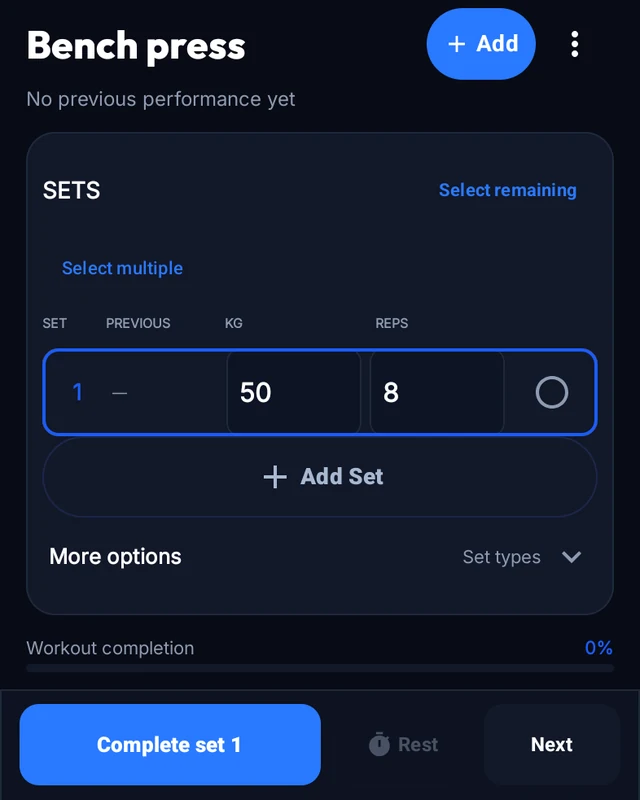
- Record the work: track exercise, sets, repetitions and load so progression is based on completed training rather than memory.
Systematic reviews report that strength training can improve strength and may improve running economy or performance in some runners, but results are not identical across studies and no programme guarantees a specific outcome. See the review of physiological and performance outcomes and the review of biomechanical and neuromuscular outcomes.
Safety note: This is general fitness information, not individual coaching, rehabilitation or medical advice. Pain, injury symptoms or a health concern should be assessed by an appropriately qualified professional.